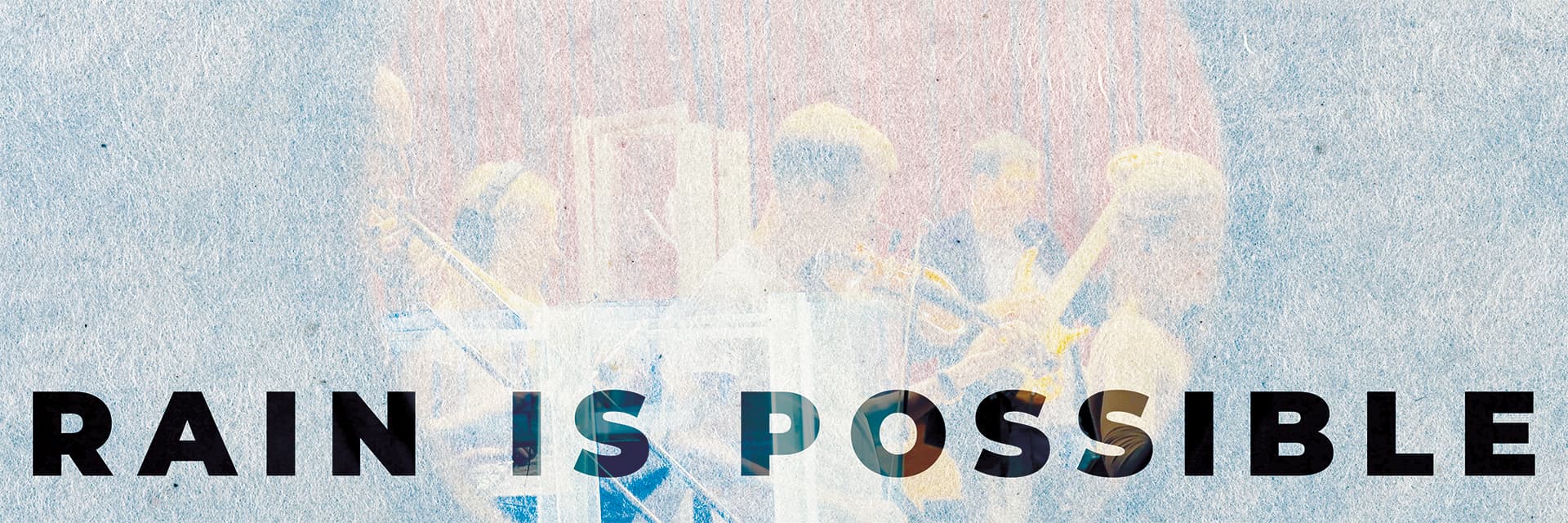

Rain Is Possible

A Stranger’s Perspective
I come from a place where music wasn’t always free.
Sometimes it was quiet.
Sometimes absent.
Sometimes controlled.
What began as a small student filming project in Estonia slowly turned into something more personal. During an outdoor performance threatened by wind and rain, I expected the event to be cancelled.
But people stayed,
The musicians stayed.
The audience stayed.
And the music continued.
That moment made me question the role music seems to play here — not only as entertainment, but as something deeply connected to memory, identity, and collective experience.
Original title
Rain Is Possible
Chapter I
Country
Estonia
Length
20 min
Original language
English
Format
5.1, 24 fps
Shooting format
Digital 4K/Color
Screen ratio
16:9
Synopsis
A filmmaker from another cultural background arrives in Estonia to document a small student music project. What begins as a simple recording session slowly changes when an outdoor performance faces worsening weather and possible cancellation.
As musicians continue preparing and audiences quietly remain under the rain, the filmmaker begins to notice something deeper beneath the event itself — a relationship between music, memory, and collective identity that feels unfamiliar, yet strangely powerful.
This film is not trying to explain Estonia.
It is an attempt to observe it — to stay with it — and to understand, even if only partially, what holds it together.
Future of the Project
What began as a single short film has gradually expanded into a larger documentary project exploring the relationship between music, culture, memory, and identity across different societies.
The next chapter of the project,
Fado in Dashti, continues this journey through a more personal and cross-cultural perspective — moving between different musical traditions, histories, and emotional landscapes.
Fado in Dashti follows Vahid, an Iranian PhD student living in Coimbra, Portugal, as he prepares a small musical performance alongside a cellist. Through rehearsals, everyday encounters, and quiet moments between cultures, the film observes music not simply as performance, but as a space for listening, recognition, and self-understanding.
The project is rooted in a personal interest in the emotional experience of migration — the subtle and often invisible process of redefining oneself far from home. Rather than approaching identity through direct explanation, the film searches for these questions through sound, presence, and shared human moments.
Visually and structurally, the film moves between intimacy and distance: private rooms and public spaces, silence and resonance, unfamiliarity and recognition. In this world, music becomes more than a language; it becomes a way of existing beside others without needing complete translation.
Fado in Dashti is part of the ongoing cinematic series Rain Is Possible, a body of work exploring how fragile forms of connection continue to survive across borders, memories, and uncertain times.


